
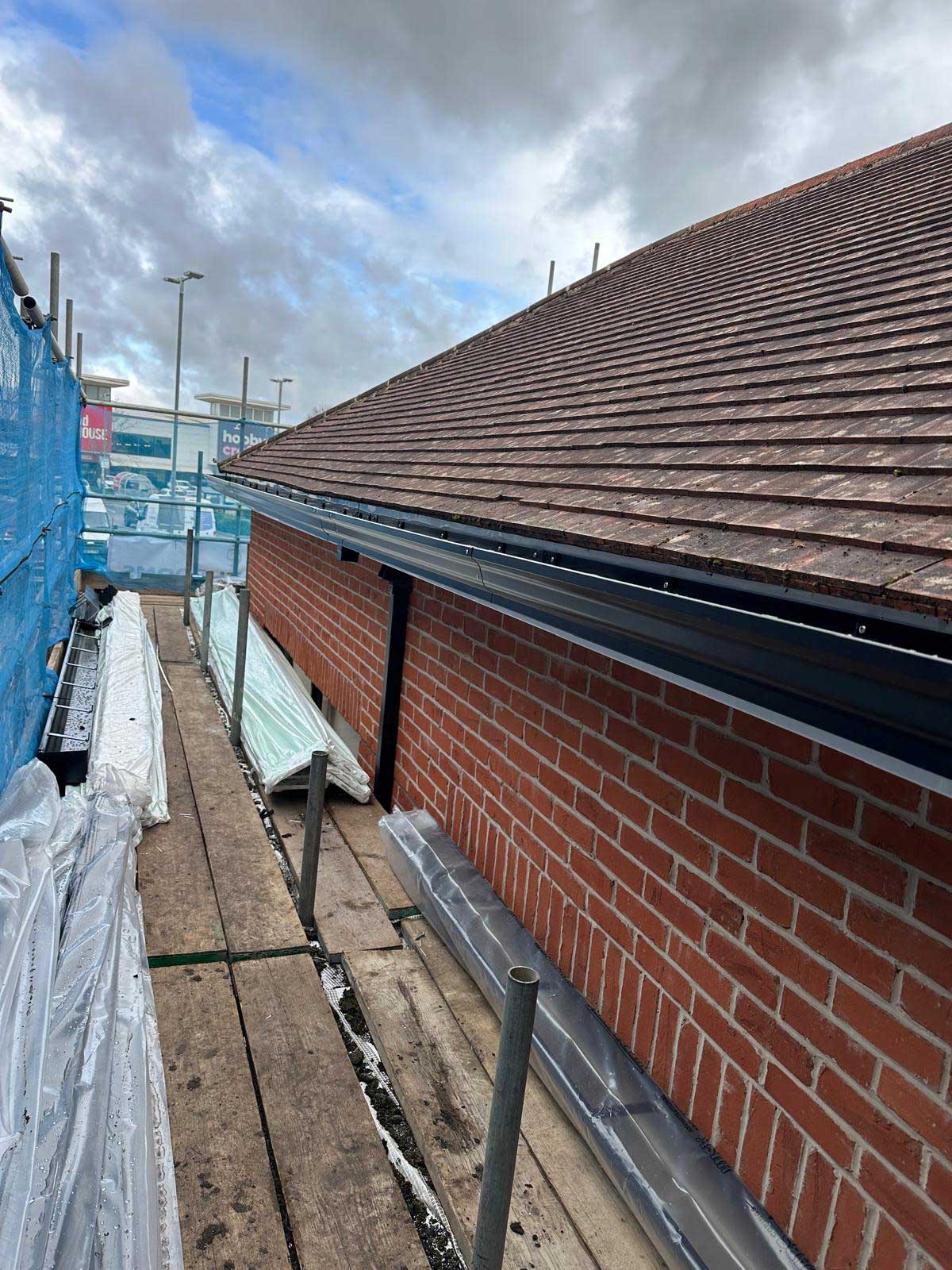
Guttering, downpipes and gutter clearing
An overflowing gutter will rot a fascia, soak a wall and find its way inside long before anyone thinks to look up. We replace, re-fall and clear guttering, and we tell you which of the three you actually need.
What we do
The detail on guttering
Cast iron, aluminium and uPVC
Cast iron is what's on most period property around here and it lasts indefinitely if it's kept painted - the failure is almost always rust at the joints or a cracked section after a frost, and individual sections can be replaced rather than the run. Aluminium is the sensible modern equivalent: seamless, rolled on site to the length of your elevation so there are no joints to fail, available in a heritage profile, and good for decades. uPVC is the cheapest and perfectly adequate on a modern house, but it goes brittle and discolours with UV, and the joints rely on rubber seals that perish. We'll price whichever suits the building rather than defaulting to plastic.
Falls and bracket spacing
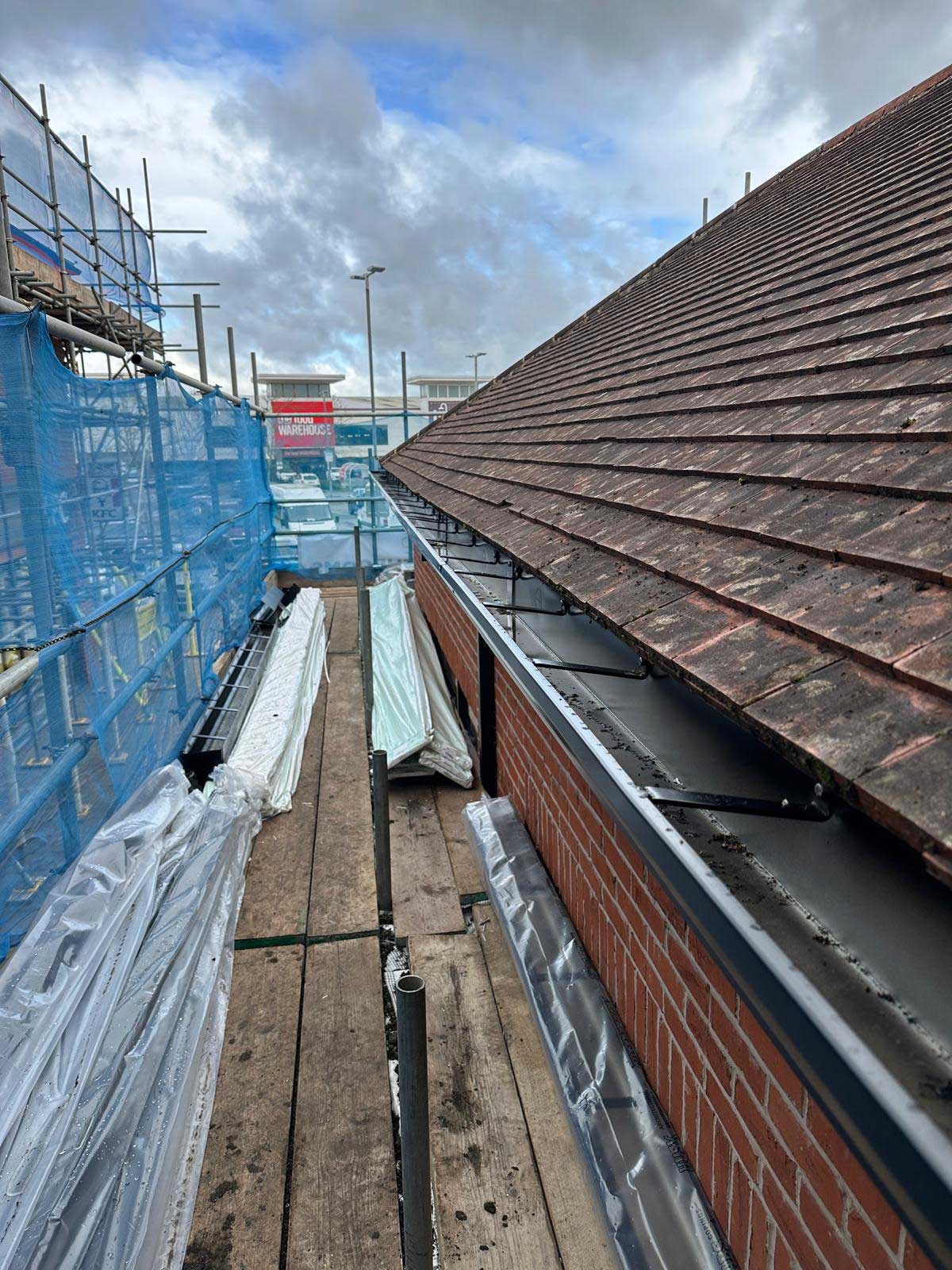
Guttering that doesn't drain is nearly always a fall problem, not a blockage problem. A gutter needs a consistent fall towards the outlet - too little and it stands water, too much and it overshoots at the outlet in heavy rain. Brackets need to be at roughly one-metre centres, closer where snow load is likely, and a run that sags between brackets holds water at the sag and eventually splits. When we replace a run we set the falls with a line rather than by eye, which is the difference between a gutter that works and one that looks fine until it rains hard.
What an overflowing gutter actually costs you
Water running over the back of a gutter goes straight onto the fascia and into the rafter feet. Water running over the front soaks the wall below, and on a solid wall that shows up as damp inside. Neither is expensive to fix at the gutter; both are expensive once the timber has gone. If you have a green stripe down your wall, moss growing at the base of it, or a fascia that's gone soft, the gutter above it has been overflowing for a while.
Downpipes, gullies and leaf guards
Half the gutter problems we're called to are actually downpipe or gully blockages - the gutter is fine, the water has nowhere to go. We rod the downpipes and clear the gully at the bottom as part of a clearing visit. Where you've got trees close by, leaf guards are worth fitting, though they need occasional checking themselves; a leaf guard that's silted up is a blockage of its own.
Clearing
Most houses around Chesham want their gutters cleared once a year, and twice if there are trees overhead - autumn is the obvious one, and a spring visit catches the moss and grit that comes off the roof over winter. We clear by hand from the ladder or scaffold rather than blowing debris onto the roof, bag it, and check the joints and brackets while we're up there.
How it works
Four steps, in this order
01
Free inspection
We come out, get up and look properly, and photograph anything you can't see from the ground. If it turns out you don't need the work, we'll say so.
02
Written fixed quote
You get the price in writing with the materials named and the scaffold and waste included. It doesn't move unless we find something hidden and agree it with you first.
03
Scaffold and works
We book the scaffold, give you a start date and keep to it. The site gets cleared at the end of every day, not just at the end of the job.
04
Sign-off
We walk you round the finished work with the before and after photographs, clear the scaffold, and leave you the details of what was used and where.
What it costs
How we price guttering
Clearing is priced per visit by the size of the property. Replacement is priced by the metre run plus downpipes, and the material you choose makes the biggest difference - uPVC, aluminium and cast iron are meaningfully different numbers. We'll quote the options side by side so you can see what you're choosing between.
Questions
The things people ask
How often should gutters be cleared?
Once a year for most houses, twice if you have trees overhanging. Autumn after the leaves are down is the important one.
Can you replace just one section of cast iron?
Usually yes. Matching sections are still available in the common profiles, and replacing a single cracked length is far cheaper than a full run. We'll tell you honestly if the rest of the run is close behind it.
Is aluminium worth the extra over uPVC?
On a period property, or on a long elevation where joints would otherwise be the weak point, yes - it's rolled seamless on site and it won't go brittle. On a modern semi with short runs, uPVC is perfectly sensible.
My gutter overflows but it's not blocked. Why?
Almost always the fall is wrong or a bracket has dropped, so water stands and backs up. Sometimes the outlet is undersized for the roof area. Either way it needs re-setting rather than clearing.
Do you fit leaf guards?
Yes, where there are trees close enough to justify them. They reduce clearing frequency but don't remove it - they still need checking, because a silted guard blocks just as well as a full gutter.
Where we work
Guttering across Buckinghamshire and west Hertfordshire
We carry out guttering in Chesham, Chesham Bois, Ley Hill, Hyde Heath, Amersham, Ashley Green, Latimer & Chenies, Little Chalfont, Bovingdon, Great Missenden, Berkhamsted and Chalfont St Giles, and everywhere else within 10 miles of Chesham. See the full list of areas we cover.
Related services
Need guttering doing?
Tell us what the roof is doing and we'll come and look at it. Free inspection, written fixed price.